Monday, July 2, 2012

Gag Grouper: Back in Season

After many months of throwing big Gag Grouper back in the water and watching them swim past my spear gun without being able to pull the trigger, they have finally come back in season! Danny, Jonny, Dustin and myself left the dock early this morning in hopes of filling the cooler with grouper slabs. I went to take the pinfish out of a bait hotel I had filled up and left at the Marina on Friday only to find that someone else got a lot of nice baits without much effort yesterday. So for about the next hour and a half we worked on trying to fill the bait well, you can never have too much bait.

Dustin showing off our catch
It was a flat calm morning and the water is finally starting to clean up after Tropical Storm Debbie made a mess of things in the Gulf. We tried a few ledges in 50 - 60 feet of water only to catch the typical 18" Red Grouper. But after going to a ledge in 85 feet of water we quickly dug seven big Gags off the bottom and into the cooler. It feels a lot better throwing a fat Gag into the cooler than it does throwing one back into the water! Just when we were about to leave, a school of small Mahi Mahi showed up and mixed the action up. We ended up catching eight of them on jigs and small pieces of sardines. We would leave one in the water until someone else hooked up, in this way we were able to keep the school at the boat. After the last few took off we moved on to a mitigation area near the pipeline for our last stop.

My Cobia and cool sunglasses
On the way I chunked up a bonita and a bunch of threadfins for chum. When we arrived we were happy to see that we had the spot to ourselves. That's the benefit of having Mondays off. We began chumming in hopes of rising the snapper. I don't know if it was the full moon or what, but we could not get the snapper bite going. Our chumming efforts weren't in vain though. Dustin yelled, "Look, two sharks!" and I quickly corrected him, "Cobia!" I scambled to put a threadfin on my free-line set-up. One of them was huge, at least 6 feet long and man was he thick! The smaller one grabbed my threadfin, spit it out and then swallowed it again, the fight was on. I was expecting the big one to stick with him but unfortunately it took off, not to be seen again. After a nice fight that broke in a new heavy spinning rod set-up I put together over the weekend we gaffed a beautiful 40" cobia and put it in the cooler to join the other fish.

Huge American Red Snapper
After a few more fish we decided it was time for the last effort of the day. I brought a dive tank along for insurance. I suited up and because I knew that the big Cobia was still lurking somewhere out there, I elected to use a line shaft with my spear gun; I'm glad I did. When I reached the bottom that was littered with rock piles at 95 feet, I was greeted by a big Gag Grouper. He watched me swim down above him and as I neared shooting range he began to retreat. I took a long shot and missed. As I was retrieving my spear a huge American Red Snapper came swimming up beside me to see what the action was about. In a panic I put the shaft back in the gun and tried to load my band. In my haste I didn't lock the shaft in right and it came back out. I tried to calm my nerves as I carefully locked the shaft, loaded the band and without rewinding my line, shot the snapper as he quartered away. The shot went through it's stomach and it took off, taking me for a ride. I thought for sure it was going to rip off as snapper do so often when shot through the soft belly. I managed the get to it and grabbing the end of the shaft, I pinned it to the sand as I wrestled to put my kill ring through it's eyes. When it was secured I let out a Turtle Man holler under the water. I think I was the most excited I have ever been spearfishing. I continued on to shoot a Gag, a red grouper and two mangrove snapper. It was amazing how many huge fish were down there but at 95 feet a tank burns up quick and soon it was time to make my ascent.

Jonny with some small Mahi Mahi
When I got to the boat I was congratulated and we snapped a couple pictures of the 30" Red Snapper that was the icing on the cake for our day. Red snapper go out of season next week and due to the unusually windy June we've had it will most likely be the only one we have the privilege of eating this year. Red Snapper are my favorite eating fish in the Gulf and I am going to savoir every bite of it. But Gag Grouper are going to remain in season for a couple months to give us something to look forward to. At the end of the day we had a limit of 8 Gags, 2 Red Grouper, a Flounder, a Cobia, 8 Mahi Mahi, and a giant American Red Snapper. Not too shabby; now the hardest decision for us is what's for dinner: blackened Mahi Mahi, grilled Cobia? Grouper sandwiches? There's a lot of possibilities.

Monday, June 4, 2012

June Flats Fishing in Tampa Bay

The full moon was still hanging low in the western sky on an early June morning as I left the dock in my Carolina Skiff J16 to fish the flats of Tampa Bay. I took a quick run to the Terra Verde bridge and with a few casts of my Cracker bait net I filled the baitwell with threadfins and pilchards. Just in time for the first light of morning to begin illuminating the horizon.

I headed to an immense grass flat, keeping my eyes pealed for schools of mullet. It didn't take long to see them. Covering an area nearly the size of a football field was a huge school of mullet. I motored upwind and drifted through the school casting a gold jig that resembles a shrimp. The first two casts landed two large trout. Lately I've been killing the trout first thing in the morning when I can find the schools of mullet out on the open flats in three to four feet of water. The trout will follow the mullet feeding on shrimp and baitfish the mullet stir up. The sun was just starting to rise by the time I had three fat trout in the cooler.

Next stop, redfish. I cruised around a mangrove island to a deep channel that runs against a mangrove edge with a dock house that looks completely out of place on this remote stretch. I cut up a ladyfish I had caught while trout fishing and put a chunk on my jig head. Tossing it up under the shade of the dock it was only a matter of minutes before I was wrestling a big fat redfish around the dock pilings. Thanks to PowerPro line I was able to pull it around a piling and into the boat, a beautiful 24 inch redfish. I would have stayed for more but I had ambitious thoughts of keeping a limit of trout and redfish and then going for a grandslam with a snook and a tarpon.

Earlier in the week I had hooked a big snook on a ladyfish while fishing a small jetty near the Skyway bridge. I motored back out to the deeper flat to catch a fourth trout and hopefully a small ladyfish for snook bait. The trout came easy enough but I couldn't find a ladyfish to save my life. It's funny how that works, usually I catch them all day long but when I'm trying for them they are illusive. After catching a bunch more trout, I decided I would have to settle for threadfins and pilchards in my quest for a snook and tarpon. I burnt the rest of the morning fishing the Skyway with only a shark to show for my efforts. So much for the vision of completing my first grandslam. I realized I was having more fun on the flats so I went back.


The tide was now all the way in so I started at the dock where I had caught the redfish and pulled my way along the mangroves, throwing a white jig against the line of submerged roots. It wasn't long before I connected with a pretty little redfish. As I came around a corner I realized that I wasn't the only one working this edge. A group of dolphins were coming towards me, ambushing mullet stacked up against the mangroves on the high tide. They would explode on the fish, often throwing mullet ten feet in the air before eating them. It was cool to watch but didn't help the fishing much.

The sun was now high and the wind was kicking up so I decided it was time to go home and see what the family was up to. My little boys were excited to see my catch, Judah always likes handing me each fish before I filet it. After getting everything cleaned up I asked what they wanted to do, "Go fishing!" was their reply. Not feeling up to hooking the boat back up, I took them down to Joe's Creek and helped them dig up a bucket of worms. They slayed the little bass, catching well over a dozen of em' along with some bluegills. Like father like sons!

Monday, May 28, 2012

Public Land Hog Hunting Strategies

Public Land Hog Taken at Citrus WMA
When it comes to still hunting hogs, the most common approach is to bait them up. I've shot a ton of hogs over corn feeders on private property and there is no arguing that it is a productive method; but affordable access to private hunting property in Florida can be hard to come by. The other option is public land. There are tons of Wildlife Management Areas throughout Florida that have unreal Hog habitat, but there is no baiting of wildlife allowed on any public land. This means finding an approach that requires a little more brain power than throwing out corn and hanging a stand. In this post I'm going to share some tactics that I have picked up on from listening to others and from my own experience of hunting public land.

Hogs basically have three things on their minds:

1. Feeding

2. Staying cool

3. Breeding

We all know that hogs eat like, well... pigs. I raised a couple little wild hogs and I was amazed by how much they really ate. They would let the whole neighborhood know when they were hungry with their squealing and grunting. When I would bring them their mush they would go crazy over it like they hadn't eaten in years. Hogs eat and they eat a lot!

When my hogs weren't eating, they were trying to stay cool by bedding up under hay or laying in muddy wallows.

I ate them before they reached breeding age so I never did see how that effected their behavior, but I do know that mature hogs breed year around whenever they have the opportunity. Since it's an ongoing thing we're not going to target the hog rut like we do deer.

The secret to a higher success rate is between the bedding area and the feeding area. For starters we need to learn to read their sign. The most common hog sign is rooting because it looks like a land clearing crew went through the property. In my early days of hunting hogs I would set up over a heavily rooted area but never had any success. The reason is that most rooting takes place at night and can be a long way from where the hogs are actually bedding. Also, when hogs root up an area they tend to move to new ground rather than looking for food where they have already rooted. Rooting areas are not a great place to hang a stand but they are a great place to start scouting.

Once I find a rooting area, I look for trails leading to it. Hog trails are well defined and are often marked by dried mud caked on the grass and leaves. Once I find a trail, I start following it. When I do this I usually find myself on a little hog highway with side trails and intersections going in different directions. When I find the most well defined trail that leads to water, I've found the highway to hog heaven.

Hogs don't sweat and they run a high body temperature, so they look for wet areas to stay cool during the day. As long as it's somewhat warm out, which is most of the year in Florida, hogs are going to be bedded in a wet area. For some WMA's this doesn't help narrow down a spot much because the entire property is under water. But for the WMA's that are relatively dry, find the pond or the marsh and the hogs will be concentrated there.

I look for wallows, muddy rubs on trees and droppings. Also I will follow my nose. I've been able to smell the stench of a musky boar bedded up from 50 yards away. These are a sure sign that I'm near their bedroom. Typically, hogs are much more active at night, so if I can find a spot right outside of their bedroom I will have a much better chance of catching one during legal shooting hours. Once I'm confident I'm close, I try to control my curiosity from tromping into their beds and spooking them, which will often cause them to find a new bedding area. I will set up my stand on a main trail leading out of their bedding area. With such a spot I've just upped my odds of catching a hog coming back from feeding in the morning or leaving for the evening.
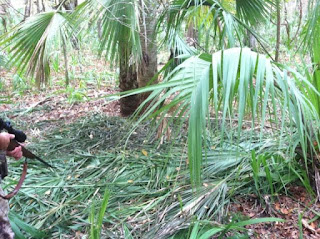
Winter Hog Bed In The Palmettos
Now there are a couple months out of the year when the weather is cold and the hogs will stray from the water and move into the higher hardwoods and pine flats. They will feed on acorns and usually bed under mature palmettos. When I see sign of this I will set up right on the edge of the palmettos. In these areas their trails are less defined and it's more of a matter of hoping they come out of the thick palmettos close enough to get a shot. I usually hear them long before I see them and if I'm on the ground I try to follow my ears and find a spot to cut them off.

While facing a big boar on the ground is definitely a little more unnerving than being safe in a treestand, there are many benefits to hunting hogs from the ground. First is the benefit of maneuverability. If the hogs don't come right to me, they are much easier to put a stalk on than deer. Also if I am archery hunting a big boar I have a better shot angle from the ground than I do from a treestand. I have shot several big boar from a treestand that were protected by their thick armor plate that covers the upper part of their shoulders. I'm shooting a 70 lb. bow and I have shot boar at 15 yards behind the shoulder and they run off with my arrow sticking a few inches in. They don't bleed at all on the outside and I never find them. From the ground there is the benefit of being able to take a low heart shot right behind their armpit. This is the only bow shot that will make for consistently recovering big boar.

One thing about hogs, especially boar, is that they are a lot tougher than a deer and a lot meaner. Even a good shot on a big boar is no guarantee that he will be dead in 20 minutes. Give him plenty of time and be very careful tracking. I've had some really close calls tracking big boar that weren't even close to being dead. They will let you get within inches before they jump up and charge! I've learned that the hands and knees blood trailing method through palmettos at night is a really, really stupid idea! Be ready to shoot, run, or climb a tree; maybe all three in order! Happy hog hunting.

Sunday, May 27, 2012

It's Always Hog Season

Turkey season is done and over and I've been trying to satisfy my passion for the outdoors with fishing and diving. But there's just something about being in the woods that's hard for me to lay down all summer long. When I start feeling the off season hunting bug biting I think of hogs. Here in Florida there's no season on private land for hogs; so if your brave enough to endure the heat, mosquitoes, snakes, gators and skunk apes; it's game on all year long.

I haven't been fortunate enough yet to find private land to hunt hogs free of charge; so my go to spot is a private cattle ranch in Zolfo Springs that runs half day hog hunts for $100. I've been doing hunts with the ranch owner, Dennis, a sixth generation Florida Cracker, for about 7 years now and we always have a great time. It's not a guaranteed kill and I've definitely been skunked my fair share of times; but there are plenty of hogs on the property, not to mention the pleasure of always seeing deer and turkey. More times than not I have brought home the bacon.

Last August I did a morning spot and stalk archery hog hunt with two of my brothers, my nephew and a friend. I dropped the first hog, a nice 150 pound bar hog, by 8 a.m. and was waiting to get picked up by the rancher while the others continued to hunt. I was sitting on the hog in the middle of a dirt road while talking to my wife on the cell phone. A big boar came out of the swamp and began trotting down a fence line right towards me. I quickly cut the conversation short and got an arrow ready. The hog didn't even notice me until he was about 20 yards away. He stopped at the fence line and I poked a pass through shot behind his shoulder. He came right at me as I jumped out of the way! He ran through a small pond and into a cow pasture. I flung my last arrow at him and then watched him run into a brush line.

About this time the rancher showed up and we began following a good blood trail. A little while later we came upon the boar bedded up under a head of palmettos. He looked dead still accept for his ears that would flicker from time to time. Since I was out of arrows and didn't bring a gun, the rancher decided to use the only gun he had with him to try and put this huge boar down. A 22 pistol with snake shot; bad idea. He snuck as close as he could and took a shot at the boar's head. The beast jumped up and trucked down a thickly brushed ditch line. My brother arrived to see what the commotion was about and I borrowed his son's 243 youth rifle. We slowly worked our way down the ditch line. It wasn't long before we came upon a black boar that stood up and began walking away through the brush. I lined him up in the scope and dropped him. When we got to the boar we found that he was a monster, weighing every bit of 300 pounds! We also found that he was a different hog than the one we were tracking; we never did find that one. I headed back to butcher my hogs while the others continued to hunt. By the time Noon rolled around they had put down three more nice hogs. We were sweaty and exhausted but it was well worth the effort.

I went there again in December with my sons Israel and Judah. After sitting in the stand with no luck we did some spot and stalk hunting and came upon a group of hogs going into a cypress swamp. Israel got his first pig, a fat bar hog, with a little help from Dad. A week later in December I shot at a huge boar while hunting Citrus WMA with a friend. We were looking for blood in thick palmettos when I came upon a very large sow bedded up with piglets. She charged me from about 10 yards and I shot her in the head with my 30-06 while falling backwards in surprise and fear! At the end of the day I had a huge sow and two tender piglets, which were very delicious roasted whole.

So here's my dilemma; I want to go hog hunting again but still have way too much pork in the freezer to justify spending the $100. I did however just take out two bags of backstraps to thaw and I'm going to try to try to shrink that dilemma on the grill this Memorial Day. If I can find enough family and friends who want to have a couple good cookouts, it shouldn't be long before I can pick up the phone and give Dennis a call. I've got a brand new batch of arrows and my Matthews Switchback XT is rearing to let one fly through a fat Florida hog. I think next time I'll bring a gun too, just in case.

Monday, May 14, 2012

Spearfishing 2012: Round 2


Some people go diving for a magical underwater experience; a peaceful escape from the loud and busy world above. Not me; if I wanted a magical underwater experience I would just watch The Little Mermaid with my daughter. I think diving is a hassle. All the awkward heavy equipment that needs constant maintenance and refills, the headaches, and the feeling of being plain tuckered for the rest of the day. I dive for one reason and one reason only; to put as many fish on my kill ring as possible.

Today I filled my kill ring with fish and soon after I filled my family's bellies with fresh fish tacos thanks to a successful day of spearfishing in the Gulf of Mexico. Hogfish, Mangrove Snapper and Scamp were on the menu. There's nothing tastier than bringing high quality fish straight from the water to the frying pan and in my opinion there's no quicker way to get a mess of high quality fish than spearfishing.

This was my second day of spearfishing this year and the results were close to last week; lots of Hogfish, some nice Mangrove Snapper and an occasional keeper Red Grouper and Scamp. There were also plenty of Gag Grouper but they are still closed for harvest.

My first dive was in 30 - 40 feet of water with lots of rock piles. At one point I had a Hogfish lined up and then a big Gag Grouper swam right in front of him and stopped. I had to wait for the Gag to clear before I popped the Hogfish. At the end of the dive I found myself staring face to face with a huge Gag that was every bit of 34 inches. I excercised restraint and watched him slowly turn and swim off into the blue.


My second dive was a mitigation area near the pipeline in 60 feet of water with large chunks of concrete littering the floor. The visibility was better than the first spot and the Snapper were also a notch bigger. The clear water allowed for some good footage with my GoPro HD camera mounted on my head. Here's the YouTube link that tells the whole story. Enjoy! 


Friday, May 4, 2012

Managing Your Deer Property: Sometimes Less is More

Over the years I've read a lot of articles about managing your hunting property to enhance its potential to hold more deer: Food plots, supplemental feeding, bedding areas, creating water sources, planting trees and even fertilizing the natural browse have been covered thoroughly. Usually these articles end like some kind of commercial; giving you the opportunity to purchase the newest secret to make your property teem with deer come Fall; but I have accidentally stumbled upon a land management system that has had proven results long before hunting became a major marketing industry.

For years my brother Jacob and I have taken great pride in trekking up to our hunting properties in Georgia before the season opens to work on the land: Food plots, feeders, trail cams, shooting lanes, fertilizer, etc. We share our bigger lease with 18 other members and many of them drive up throughout the year to work on the property. In recent years there have been more food plots, more feeders, more mineral licks, more stands and more shooting lanes, yet less deer seen. What is going on? Maybe we need to stop asking Bass Pro Shops what deer want and ask the deer. But that is not easy. Whenever I get close to a deer on my hunting properties  they blow and run away as fast as they can before I can ask them a question. It's almost like they don't want me there. What a lack of appreciation for all the work I've done for them!

It's time to burst our bubble as land managers; deer don't want us and they don't need us. The best hunting property we could acquire, at least in my neck of the woods, is not a property that has been extensively managed but a property that has never been hunted. Native Americans understood this and they would move their entire tribe to find the illusive, untouched "Happy Hunting Grounds" rather than start planting food plots and putting corn feeders up to attract more deer. Sometimes the best thing we can do to enhance our property is just leave it alone.

Bucked out in the early years of hunting small lease
Besides our big lease, my brother and I also share a small lease. It started out as 250 acres owned by a farmer and leased by 4 of us. The farmer had not allowed hunting on the property for many years before we acquired it and the first couple years it was banging. I took 5 - 6 deer every season for the first three years. One of the members lived near the lease and he would routinely walk the property, check out all the stand set-ups as well as fill feeders and check trail cams. The hunting quality of the property slowly declined. Last year the farmer sold off all but 60 acres of which my brother and I continued to lease. I hunted the property one evening in September but besides that we neglected it, didn't even touch it.

Last week we went up for a final turkey hunt and to move my stands off the big lease; as I am dropping it. When we arrived to set up my stands at the small lease we were amazed at the amount of deer tracks on the fields. It looked like they were using the fields as a race track. We talked to the farmer and his wife and they have been seeing deer everywhere. He had sweaty t-shirts hanging around his blueberry field to try and keep the deer out of them. We walked down a little creek bottom to hang a lock-on stand and as I was half-way up the tree screwing in steps, a big bodied buck with his first nubs of velvet came tromping down the creek bottom right towards us. It was 1 o'clock in the afternoon and he was walking like he had thrown caution to the wind. When he finally looked up and saw my brother and nephew standing at the base of the tree at 15 yards he about jumped out of his skin! He felt secure because this spot hadn't any human activity in years.

On the ride home we had time to reflect on how human activity effects deer activity. I do still believe there is a place for food plots and supplemental feed stations but the pros must be carefully weighed against the cons  of disturbing the deer's sense of security. I know there have been times where I find an awesome spot for a stand with plenty of deer sign and I try to enhance it only to ruin it. There was a reason the deer liked to frequent that spot and for me to put up a feeder, cut shooting lanes and set up trail cams might ruin the reason they felt safe to come there in the first place.

I realize that land management methods work differently around the country, but here in the Southeast I am dealing primarily with swamp deer that want above all else cover and solitude. The best stand set-up I can find is the place that is most untouched by human activity. With that in mind I will have a lot less work to do this year before the season starts as I am taking a less is more mentality on the little piece of property I have to hunt in Georgia this year. Besides that, I will be hunting Florida Public Land and the same mentality most certainly applies there as well. These are just some personal thoughts about land management that you can feel free to agree or disagree with. I can hardly wait for Fall to put this theory to the test!    

Saturday, April 21, 2012

Gearing Up For Spearfishing

I was looking through some old files on my computer the other day and came across my spearfishing video folder containing many of my dives from last summer. Watching my head mounted GoPro HD camera capture my dives shooting Hogfish, Gag Grouper and Mangrove Snapper got me amped up for this season.

I've been spearfishing in one form or another since I was a kid. It started with a pole spear around the dock lines for sheepshead and continued to free diving the artificial reefs in the Gulf of Mexico. For a while it was an obsession. I would spearfish year round, wearing a hooded wetsuit in the winter. Early in my marriage I wanted to go spearfishing but my wife wanted to go on a date. I thought I could shoot two fish with one spear by taking her on a date to watch me spearfish from the seawall. Bad idea.

Seven years ago I fell from grace in the eyes of "true spearfishermen" and became Scuba certified. I became too fat for my wetsuit and haven't thrown down the money for a new one. Now spearfishing is more of a seasonal thing for me. My boss and pastor, Danny Hodges, tries to go offshore spearfishing every Monday in the Summer, weather permitting; and I am fortunate enough to be on his A-list of dive partners. With the water warming quickly it is time to get back on it!

One of the best perks of spearfishing the Gulf of Mexico is the Hogfish. They are really tough to catch on hook and line gear but are plentiful and super easy to spear. They seem to be genetically programmed to swim slowly in front of a speargun and turn broadside. Did I mention that they are killer table fare? The whitest, flakiest fillet you will ever eat. There is one small ledge we call Marilyn's Birthday that is our go to spot for Hogfish. I can usually hang in one spot and limit out in a matter of minutes. As I shoot one I keep my eye on the next victim as they wait in line to swim in front of my spear; stupid, delicious fish!

One thing that I am bummed about is the fact that Gag Grouper harvest is closed till July this year. One of my favorite parts of spearfishing the Gulf is sticking a big Gag hanging in the sand off the ledge. This winter and spring we have caught more big Gag Grouper than I have ever seen in 30 years of fishing the Gulf, but according to the tree huggers at NOAA they are over fished and very scarce. So until July I will have to pass on the Gag. It will feel like passing on a big buck while doe hunting.

But I need to stay positive and think about Mangrove Snapper, Hogfish, Scamp and Red grouper. Not to mention Amberjack, Cobia, and others that can be taken with a speargun. So it's time to inspect the gear, fill the tanks and clean the grille for the best eating the Gulf has to offer.